Helen Keller
Helen Keller: blind and deaf, she graduated from college
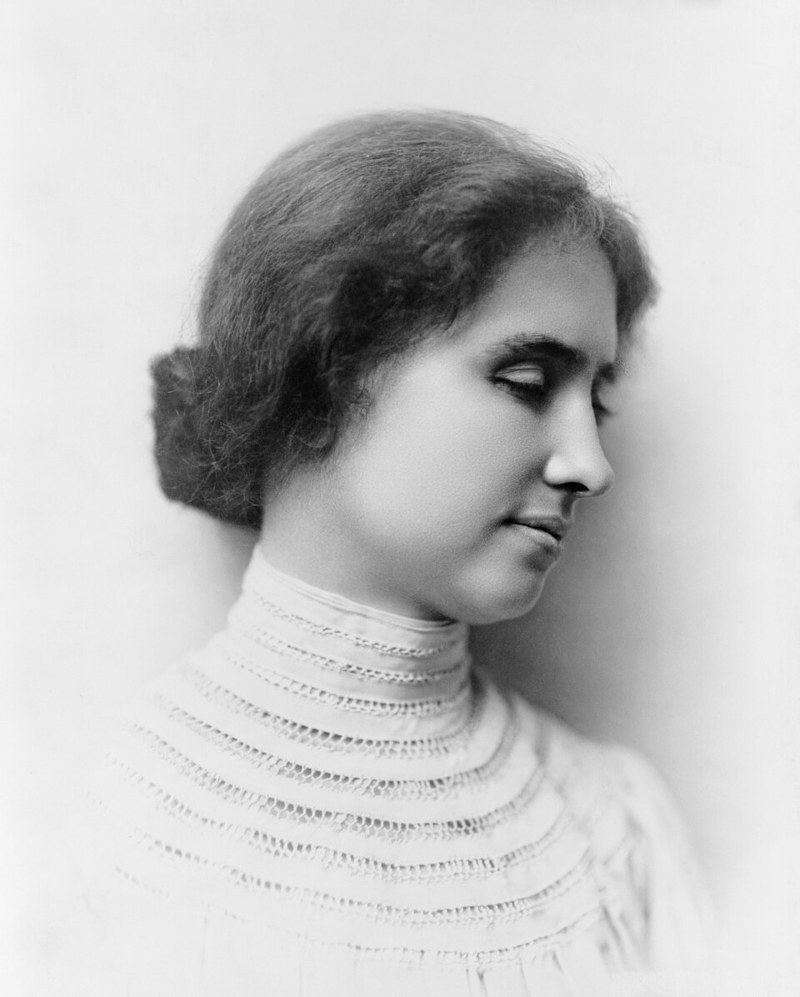
Helen Keller was an American deafblind author, disability rights advocate, political activist and lecturer. She was born on June 27, 1880, in Tuscumbia, Alabama. At 19 months old, she contracted an unknown illness described by doctors as "an acute congestion of the stomach and the brain". She recovered, but was left permanently blind and deaf: as she recalled in her autobiography, "at sea in a dense fog".
Until the age of seven, she communicated mainly through home signs. By then she had more than 60 of them to communicate with her family, and she could distinguish people by the vibration of their footsteps.
In 1886, her mother read in Charles Dickens' American Notes about the successful education of Laura Bridgman, a deaf and blind woman. Inspired, she sent Helen and her father to an eye, ear, nose and throat specialist in Baltimore for advice. He referred them to Alexander Graham Bell, who was working with deaf children at the time, and Bell advised them to contact the Perkins Institute for the Blind, the school where Bridgman had been educated. Its director asked Anne Sullivan, a 20-year-old alumna of the school who was visually impaired, to become Keller's instructor. It was the beginning of a nearly 50-year-long relationship.
Sullivan arrived at the Kellers' house on March 5, 1887, a day Keller would forever remember as "my soul's birthday". She immediately began spelling words into Helen's hand, starting with "d-o-l-l" for the doll she had brought her as a present. At first Keller struggled: she could not comprehend that every object had a word identifying it, and when Sullivan was trying to teach her the word for "mug", she became so frustrated that she broke the mug. "I did not know that I was spelling a word or even that words existed," she remembered.
The next month came the breakthrough. As her teacher made the motions on the palm of one hand while cool water ran over the other, Keller realized that they symbolized the idea of "water". She quickly demanded that Sullivan sign the names of all the other familiar objects in her world.
Determined to communicate with others as conventionally as possible, Keller learned to speak. She learned to "hear" people's speech using the Tadoma method, feeling the speaker's lips and throat with her fingers, became proficient at braille and also used fingerspelling.
After an education at both specialist and mainstream schools, Keller gained admittance to Radcliffe College of Harvard University in 1900. Her admirer Mark Twain had introduced her to the magnate Henry Huttleston Rogers, who, with his wife Abbie, paid for her education. In 1904, at the age of 24, Keller graduated from Radcliffe as a member of Phi Beta Kappa, becoming the first deafblind person to earn a Bachelor of Arts degree.
She wrote her autobiography, The Story of My Life, during her time in college; it was published in 1903, when Keller was 22. In an article she wrote in 1907, Keller brought to public attention the fact that many cases of childhood blindness could be prevented by washing the eyes of every newborn baby with a disinfectant solution. Thanks to her advocacy, this public health measure was swiftly and widely adopted.
Keller became a world-famous speaker and author and an advocate for people with disabilities. Anne Sullivan, once her governess, remained her companion until her own death in 1936; Keller held her hand to the end.
Keller devoted much of her later life to raising funds for the American Foundation for the Blind. From 1946 to 1957, she visited 35 countries. In 1954, she was the subject of the Academy Award-winning documentary Helen Keller in Her Story, and on September 14, 1964, President Lyndon B. Johnson awarded her the Presidential Medal of Freedom, one of the United States' two highest civilian honors.
Helen Keller died in her sleep on June 1, 1968, at her home in Easton, Connecticut, at the age of 87. Her ashes were buried at the Washington National Cathedral next to her constant companions, Anne Sullivan and Polly Thomson.
Timeline
Every date and figure comes from a verified claim. Select one to go to the claim and its quote.
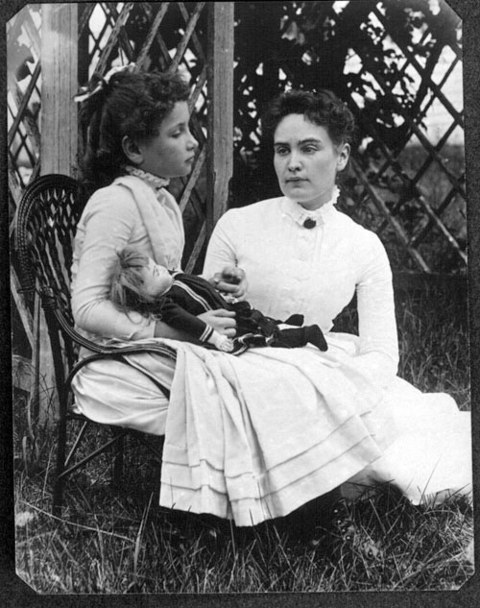
“The living word awakened my soul, gave it light, hope, set it free!”
The takeaway
Even one understood word can change a life: from "water" spelled into her palm, Helen Keller went on, despite being blind and deaf, to a college degree, books and the Presidential Medal of Freedom.
Sources
Wikipedia article: Helen Keller (opens in a new tab)
This text is adapted from a revision of the Wikipedia article (opens in a new tab) and is available under CC BY-SA 4.0.
Photo at the top: Unknown author · public domain · Wikimedia Commons (opens in a new tab)
Photo at the end: Family member of Thaxter P. Spencer, now part of the R. Stanton Avery Special Collections, at the New England Historic Genealogical Society. See Press Release [1] for more information. · public domain · Wikimedia Commons (opens in a new tab)
Claims and quotes
Every claim is taken from a Wikipedia article. Open one to see the verbatim quote.
-
Helen Keller was an American deafblind author, disability rights advocate, political activist and lecturer.
was an American deafblind author, disability rights advocate, political activist and lecturer
Source (opens in a new tab) -
Keller was born on June 27, 1880, in Tuscumbia, Alabama.
Keller was born Helen Adams Keller on June 27, 1880, in Tuscumbia, Alabama
Source (opens in a new tab) -
At 19 months old, Keller contracted an unknown illness described by doctors as "an acute congestion of the stomach and the brain".
At 19 months old, Keller contracted an unknown illness described by doctors as "an acute congestion of the stomach and the brain".
Source (opens in a new tab) -
Keller recovered, but was left permanently blind and deaf, "at sea in a dense fog", as she recalled in her autobiography.
Keller was able to recover from her illness, but was left permanently blind and deaf, as she recalled in her autobiography, "at sea in a dense fog".
Source (opens in a new tab) -
Until the age of seven, Keller communicated primarily using home signs.
She then communicated primarily using home signs until the age of seven, when she met her first teacher and life-long companion Anne Sullivan.
Source (opens in a new tab) -
By the age of seven, Keller had more than 60 home signs to communicate with her family and could distinguish people by the vibration of their footsteps.
by the age of seven, Keller had more than 60 home signs to communicate with her family, and could distinguish people by the vibration of their footsteps.
Source (opens in a new tab) -
In 1886, Keller's mother, inspired by an account in Charles Dickens' American Notes of the successful education of Laura Bridgman, a deaf and blind woman, sent Keller and her father to an eye, ear, nose and throat specialist in Baltimore for advice.
In 1886, Keller's mother, inspired by an account in Charles Dickens' American Notes of the successful education of Laura Bridgman, a deaf and blind woman, dispatched the young Keller and her father to consult physician J. Julian Chisholm, an eye, ear, nose and throat specialist in Baltimore, for advice.
Source (opens in a new tab) -
The specialist referred the Kellers to Alexander Graham Bell, who was working with deaf children at the time, and Bell advised them to contact the Perkins Institute for the Blind, the school where Bridgman had been educated.
Chisholm referred the Kellers to Alexander Graham Bell, who was working with deaf children at the time. Bell advised them to contact the Perkins Institute for the Blind, the school where Bridgman had been educated.
Source (opens in a new tab) -
The school's director asked Anne Sullivan, a 20-year-old visually impaired alumna, to become Keller's instructor; it was the beginning of a nearly 50-year-long relationship, with Sullivan as her governess and later her companion.
Michael Anagnos, the school's director, asked Anne Sullivan, a 20-year-old alumna of the school who was visually impaired, to become Keller's instructor. It was the beginning of a nearly 50-year-long relationship Sullivan developed with Keller as her governess and later her companion.
Source (opens in a new tab) -
Sullivan arrived at Keller's house on March 5, 1887, a day Keller would forever remember as "my soul's birthday".
Sullivan arrived at Keller's house on March 5, 1887, a day Keller would forever remember as "my soul's birthday".
Source (opens in a new tab) -
Sullivan immediately began spelling words into Helen's hand, beginning with "d-o-l-l" for the doll she had brought her as a present.
Sullivan immediately began to teach Helen to communicate by spelling words into her hand, beginning with "d-o-l-l" for the doll that she had brought Keller as a present.
Source (opens in a new tab) -
At first Keller could not comprehend that every object had a word identifying it; trying to learn the word for "mug", she became so frustrated that she broke the mug.
Keller initially struggled with lessons since she could not comprehend that every object had a word identifying it. When Sullivan was trying to teach Keller the word for "mug", Keller became so frustrated she broke the mug.
Source (opens in a new tab) -
Keller remembered that she did not know she was spelling a word or even that words existed.
I did not know that I was spelling a word or even that words existed. I was simply making my fingers go in monkey-like imitation.
Source (opens in a new tab) -
The next month, Keller realized that the motions her teacher made on her palm, while cool water ran over her other hand, symbolized the idea of "water".
The next month, Keller made a breakthrough, when she realized that the motions her teacher was making on the palm of her hand, while running cool water over her other hand, symbolized the idea of "water".
Source (opens in a new tab) -
Keller recalled that the living word awakened her soul, gave it light, hope and set it free.
I knew then that w-a-t-e-r meant the wonderful cool something that was flowing over my hand. The living word awakened my soul, gave it light, hope, set it free!
Source (opens in a new tab) -
Keller quickly demanded that Sullivan sign the names of all the other familiar objects in her world.
Keller quickly demanded that Sullivan sign the names of all the other familiar objects in her world.
Source (opens in a new tab) -
Determined to communicate with others as conventionally as possible, Keller learned to speak.
Determined to communicate with others as conventionally as possible, Keller learned to speak and spent much of her life giving speeches and lectures on aspects of her life.
Source (opens in a new tab) -
Keller learned to "hear" people's speech using the Tadoma method, feeling the speaker's lips and throat with her fingers.
She learned to "hear" people's speech using the Tadoma method, which means using her fingers to feel the lips and throat of the speaker.
Source (opens in a new tab) -
Keller became proficient at using braille and also used fingerspelling.
She became proficient at using braille, and also used fingerspelling to communicate.
Source (opens in a new tab) -
Keller had an education at both specialist and mainstream schools before Radcliffe College.
After an education at both specialist and mainstream schools, Keller attended Radcliffe College of Harvard University
Source (opens in a new tab) -
In 1900, Keller gained admittance to Radcliffe College of Harvard University.
before gaining admittance, in 1900, to Radcliffe College of Harvard University
Source (opens in a new tab) -
Mark Twain had introduced Keller to the magnate Henry Huttleston Rogers, who, with his wife Abbie, paid for her education.
Her admirer, Mark Twain, had introduced her to Standard Oil magnate Henry Huttleston Rogers, who, with his wife Abbie, paid for her education.
Source (opens in a new tab) -
In 1904, at the age of 24, Keller graduated from Radcliffe as a member of Phi Beta Kappa, becoming the first deafblind person to earn a Bachelor of Arts degree.
In 1904, at the age of 24, Keller graduated from Radcliffe as a member of Phi Beta Kappa, becoming the first deafblind person to earn a Bachelor of Arts degree.
Source (opens in a new tab) -
Keller wrote her autobiography, The Story of My Life, during her time in college; it was published in 1903, when she was 22.
At age 22, with help from Sullivan and Sullivan's husband John Macy, Keller published her autobiography, The Story of My Life (1903). It recounts the story of her life up to age 21 and was written during her time in college.
Source (opens in a new tab) -
In a 1907 article, Keller brought to public attention that many cases of childhood blindness could be prevented by washing the eyes of every newborn baby with a disinfectant solution.
In an article Keller wrote in 1907, she brought to public attention the fact that many cases of childhood blindness could be prevented by washing the eyes of every newborn baby with a disinfectant solution.
Source (opens in a new tab) -
Thanks to Keller's advocacy, this public health measure was swiftly and widely adopted.
Thanks to Keller's advocacy, this commonsense public health measure was swiftly and widely adopted.
Source (opens in a new tab) -
Keller became a world-famous speaker and author and an advocate for people with disabilities.
Keller became a world-famous speaker and author. She was an advocate for people with disabilities, amid numerous other causes.
Source (opens in a new tab) -
Keller devoted much of her later life to raising funds for the American Foundation for the Blind.
Keller devoted much of her later life to raising funds for the American Foundation for the Blind.
Source (opens in a new tab) -
Sullivan died in 1936, with Keller holding her hand.
Sullivan died in 1936, with Keller holding her hand, after falling into a coma as a result of coronary thrombosis.
Source (opens in a new tab) -
From 1946 to 1957, Keller visited 35 countries.
From 1946 to 1957, Keller visited 35 countries.
Source (opens in a new tab) -
Keller was the subject of the Academy Award-winning 1954 documentary Helen Keller in Her Story.
She was also the subject of the Academy Award-winning 1954 documentary Helen Keller in Her Story
Source (opens in a new tab) -
On September 14, 1964, President Lyndon B. Johnson awarded Keller the Presidential Medal of Freedom, one of the United States' two highest civilian honors.
On September 14, 1964, President Lyndon B. Johnson awarded her the Presidential Medal of Freedom, one of the United States' two highest civilian honors.
Source (opens in a new tab) -
Keller died in her sleep on June 1, 1968, at her home in Easton, Connecticut, at the age of 87.
She died in her sleep on June 1, 1968, at her home, Arcan Ridge, located in Easton, Connecticut, at the age of 87.
Source (opens in a new tab) -
Keller's ashes were buried at the Washington National Cathedral next to her constant companions, Anne Sullivan and Polly Thomson.
Her ashes were buried at the Washington National Cathedral next to her constant companions, Anne Sullivan and Polly Thomson.
Source (opens in a new tab)